

ema
Amanda Ducach
Founder + CEO

Meet Amanda Ducach
Amanda Ducach built EmaEQ because too many AI answers to women's health questions are simply wrong (~60% to be clear). General models like OpenAI and Claude are powerful, but they aren't built for clinical care on their own. EmaEQ is the platform that makes AI accurate and easy to trust, right inside a company's own product.
Amanda started building the first agentic AI for women's health in 2020. The idea was simple: the model is the easy part, and the real work is the clinical framework around it. Health and wellness brands use EmaEQ across areas like fertility, menopause, lactation, mental health, and postpartum care. Partners, like Aavia and Julie Care, can run it as their AI or add it to what they already have, and go live in six to eight weeks.
The platform has powered more than 10 million conversations and handles over 90% of them on its own, and most users say they'd turn to it before Google for their health questions.
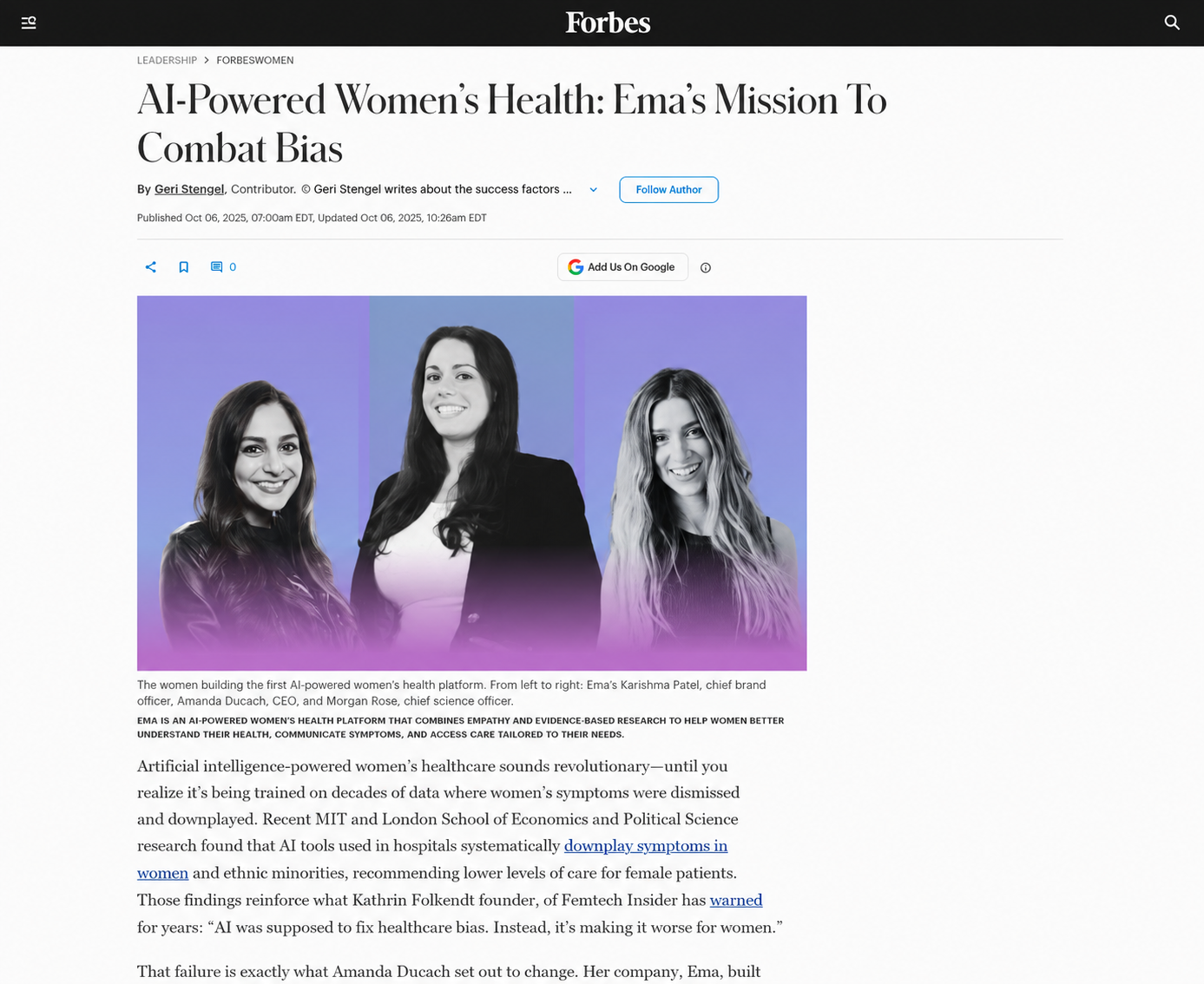
Amanda founded EmaEQ with Karishma Patel (CXO) and Vish Sharma (CTO).

What we do
Ema EQ is a health AI company at the intersection of evidence, empathy, and engineering. We’re on a mission to bring emotionally intelligent AI to every corner of health and wellness — starting with women.
Ema EQ's flagship product, Ema, was built by learning from more than 10 million real conversations between women and physicians, not from generic content scraped off the internet. This grounding lets Ema hold sensitive health conversations with genuine emotional intelligence, understanding not just the clinical facts but the context and feelings behind a question, from a first period through post-menopause. It's this combination of empathy and clinical accuracy that sets Ema apart from typical AI tools, which research has shown can downplay or dismiss women's symptoms.
Today, Ema EQ licenses this technology as a clinical AI layer that digital health, pharma, and wellness companies can build directly into their own products, so they can launch trustworthy, clinically accurate AI experiences without developing that capability from scratch. The company describes itself as a "judgment layer" sitting on top of leading AI models, one that recognizes when a question has turned clinical or when a decision should be handed off to a human provider, and its approach has been validated by 50+ clinical advisors.
What people are saying
"We didn’t set out to build AI. We set out to solve for women. This is the system that emerged."